The parcel was moving nicely: accepted, sorted, departed. And then – silence. The last status says "in transit" and has not changed for five, ten or even fifteen days. You refresh the page every morning, and nothing happens. Is the parcel lost? Is it stuck at customs? Should you already write to the seller?
The good news: long pauses in tracking are normal, especially for international shipments. The less good news: sometimes a pause really means a problem. In this guide we explain why parcels go quiet, how long a pause is normal for different types of shipments, which statuses deserve attention and what to do step by step if the waiting gets too long.
"In transit" is the most general status a carrier can show. It only says that the parcel has been accepted and has not been delivered yet. It does not say where exactly the parcel is right now.
The reason is simple: tracking is based on scans. The parcel is scanned when it arrives at a facility, when it is sorted and when it leaves. Trucks, planes, ships and containers do not scan anything. While the parcel is on the road between two facilities, or is waiting in a sealed bag for the next flight, the tracking shows the last recorded event – and it can stay unchanged for days.
So "no updates" usually means "no scans", not "no movement". A parcel can cross a whole continent without a single new line in its history.
Some stages of the journey almost always produce long pauses. If you know them, you can tell an ordinary pause from a suspicious one.
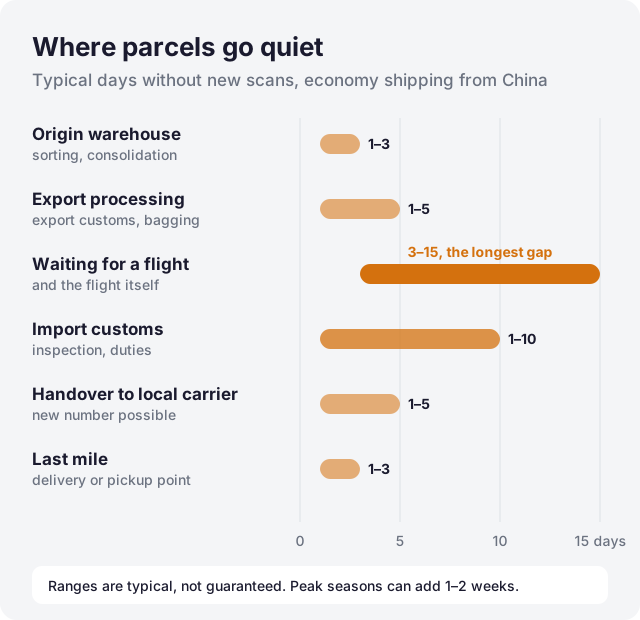
Orders from large marketplaces are often collected in a consolidation warehouse first. Parcels from different sellers are sorted, packed into large bags and prepared for export. This stage usually takes 1–3 days, sometimes longer during sales.
The bags pass export customs and are handed over to an airline or a freight operator. The status may read "export clearance", "handed over to airline" or "departed from origin country". After that, the next update may come only from the destination country.
This is the main source of long pauses. Economy shipments do not fly on the first available plane: they wait until there is free cargo space at an acceptable price. Sometimes the bags travel through one or two transit hubs in other countries. For economy shipping from China, 3 to 15 days without a single update at this stage is a very common picture.
After arrival, the parcel goes through customs in the destination country. Most small parcels are released quickly, but some are selected for inspection, and others wait for payment of duties or additional documents. This stage can take from one day to two weeks.
After customs, the parcel is handed over to the local postal service or a courier company. At this point, the parcel may get a new tracking number, and the old one stops updating. Many "stuck" parcels are actually moving under a different number.
The table below shows typical pauses between updates for different types of shipments. These are not official carrier deadlines but realistic ranges that you will see in practice.
| Type of shipment | Normal pause | Worth checking after |
|---|---|---|
| Domestic express (courier, next-day services) | up to 1 day | 2 days |
| Domestic standard (national post, parcel networks) | 1–3 days | 5 days |
| International express (DHL, UPS and similar) | 1–2 days | 4 days |
| International postal (registered mail, EMS) | 3–10 days | 14 days |
| Economy shipping from China (marketplaces) | 5–15 days | 20 days |
| Customs in the destination country | 1–10 days | 14 days |
During peak seasons, add one to two weeks to these numbers. The busiest periods are the 11.11 sales in November, Black Friday (in 2026 it falls on November 27), the weeks before Christmas and the Chinese New Year. In 2027, the Chinese New Year falls on February 6. Many factories, warehouses and logistics companies in China slow down or stop for about two weeks around this date, and the backlog affects deliveries for weeks after.
Most pauses are harmless, but some statuses mean the parcel needs action from you or the sender:
If you are not sure what a status means, our guide to tracking statuses explains the most common ones.
For an international economy shipment, use the following rule of thumb. For domestic parcels, act much earlier – after 3–5 days without updates.
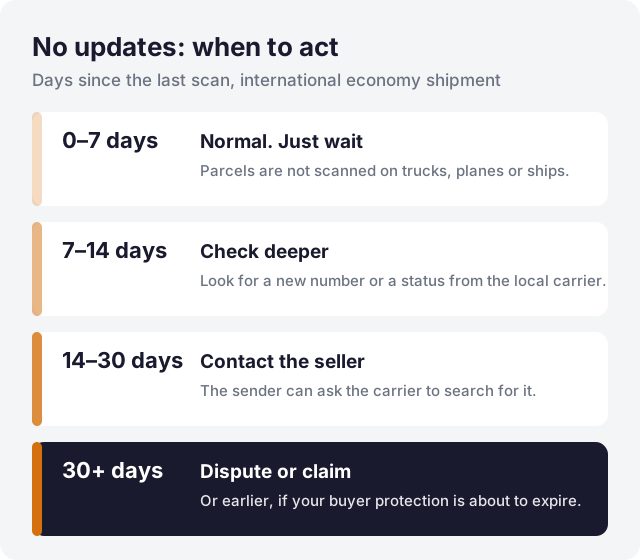
Every carrier has its own rules, but in general a parcel is treated as lost when it has had no updates for a long time and an official search has given no result. For domestic shipments, carriers usually accept a missing-parcel request after about a week of silence. For international postal items, the search is longer because it involves the postal services of two or more countries and can take several weeks.
An important detail: for international postal shipments, a search request is usually filed by the sender in the country of origin. That is why, if you bought an item online, it is often faster to go through the seller and the marketplace than to deal with the carriers yourself.
For an international economy shipment, two weeks without updates is not unusual, especially between leaving the origin country and arriving in the destination country. For a domestic parcel, it is a reason to contact the carrier.
Most often it is waiting for customs clearance or has been handed over to a local carrier under a new number. Check for customs notifications and look for a new tracking number in the latest events.
Yes, and this happens quite often. Some shipping methods are tracked only partially, and some local carriers do not send data back to the original tracking system. The parcel can simply appear at your branch or in your mailbox.
No. The page shows the scans that the carrier has already recorded. New events appear only after the next scan.
Paste your tracking number into the search field at the top of this page. We automatically detect the carrier among more than 30 delivery services, including Nova Poshta, Ukrposhta, Meest, DHL, UPS, Cainiao and Yanwen, and show the full history of the parcel in one place. If your number is not found at all, read Tracking Number Not Found or Not Working: 10 Reasons and What to Do.
 Track my package